By Ashley MacRae, Communications Coordinator
Kawartha Land Trust (KLT) takes on one of Canada’s most aggressive invasive plant species — invasive Phragmites — with the support from the Ontario Phragmites Action program.
Invasive Phragmites is found throughout Ontario, Quebec, and spreading into other provinces. It takes mighty strength and resources to address this species head-on. With the support from the Ontario Phragmites Action program’s Invasive Phragmites Control Fund, Kawartha Land Trust is monitoring and fighting the ongoing battle against invasive Phragmites right here in the Kawarthas.
What is invasive Phragmites and why is it so dangerous to our natural spaces? Let me introduce you to the European Common Reed, broadly known as invasive Phragmites, and deemed to be one of Canada’s worst invasive plants.
This hardy grass can grow up to 14 feet tall in large, dense patches through wetlands and across dry lands. They outcompete other plant species like our native cattails, affecting biodiversity. And they have severe effects on wildlife — crowding out and sometimes replacing quality habitats and food sources.
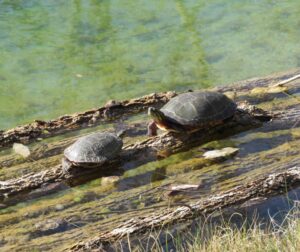
Species like our at-risk turtles are especially impacted as they cannot move through, nest in, or hatch in the thick stands of invasive Phragmites. The European Common Reed destroys entire ecosystems, harming our vital wetlands the most.
These are some of the reasons why Kawartha Land Trust has made invasive Phragmites control on KLT-protected properties one of our top stewardship priorities. In the spring and summer of 2025, thanks to the Ontario Phragmites Action program’s Invasive Phragmites Control Fund, KLT increased its efforts in managing this incredibly invasive species across multiple KLT nature preserves.
Last spring, volunteers, including members of KLT’s Volunteer Property Inventory Team (PIT crew), surveyed previously recorded patches of invasive Phragmites on KLT’s protected properties and documented any new growths or changes to the populations in these areas. This provided the stewardship team with updated data to inform next steps.
With the additional funding received, KLT partnered with a local ecosystem restoration business that specializes in wetland invasive species removal to complement and amplify our management efforts. Through this additional support, we increased our capacity to control invasive Phragmites — expanding our management from strategically targeted herbicide spraying and spading invasive Phragmites on only dry lands to also addressing it in KLT-protected wetlands across the Kawarthas.
Accessing additional resources to control invasive Phragmites in KLT-protected wetlands allowed us to triple our managed areas throughout the Kawarthas in 2025 compared to previous years of managing this invasive grass solely on dry lands.
“It felt really hopeful to see areas that were previously experiencing a localized crisis of biodiversity loss related to invasive Phragmites be given a second chance through the efforts of volunteers, community supporters, and the support of the Invasive Phragmites Control Fund,” said Hayden Wilson, KLT’s Land Stewardship Manager.
“Although we haven’t eradicated invasive Phragmites on KLT-protected properties, taking tangible steps to reduce the threats this invasive species poses and give vulnerable wetland ecosystems and the species that rely upon them a helping hand felt like the best parts of land care.”
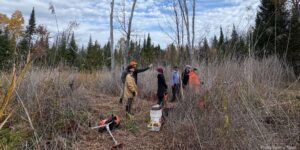
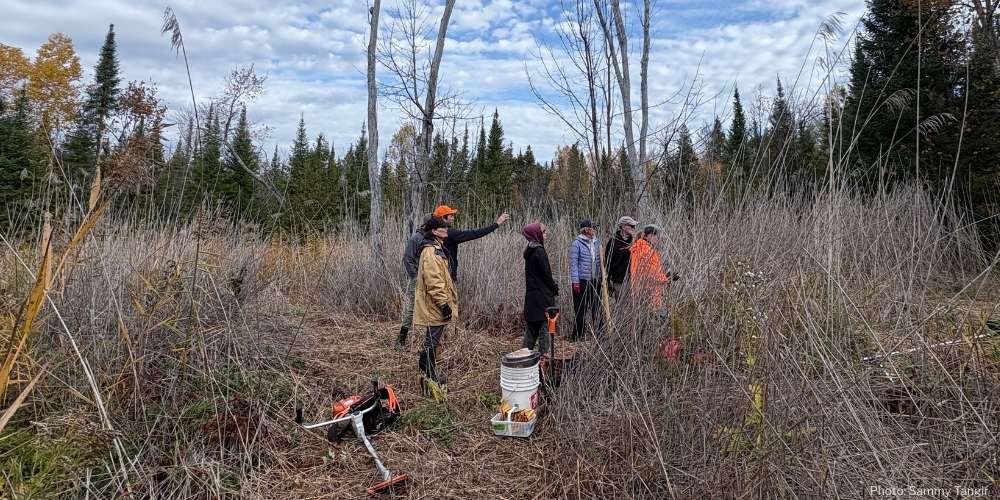
With the management successes from the 2025 field season, the KLT stewardship team and volunteers, including the Regional Seed Team, began restoration work on two KLT-protected properties later that fall, including one of our most impacted sites. Scattering local native seeds and live staking native shrub cuttings is the beginning to establishing thriving wetland ecosystems.
Soon, we’ll get to witness the renewal of a vibrant Cattail Marsh, abundant with Swamp Milkweed, Asters, Willows, and Dogwoods, among many other native species. Over 30 re-introduced plant species will create habitats for a greater biodiversity and welcome Marsh Wrens, dragonflies, and our many at-risk turtles back to this wetland.
Invasive Phragmites control is a multi-year process requiring intensive management. KLT is grateful to the Ontario Phragmites Action program’s Invasive Phragmites Control Fund and KLT supporters for ensuring this important work happens on the lands that we love.
The Invasive Phragmites Control Fund is made possible through funding from Ontario’s Ministry of Natural Resources and facilitated by the Invasive Species Centre and Nature Conservancy of Canada through the Ontario Phragmites Action program. The purpose of the Invasive Phragmites Control Fund is to assist local groups and organizations with on-the-ground control of invasive Phragmites to reduce the provincial fragmentation of management of this invasive species.
The views expressed here are those of the Kawartha Land Trust and do not necessarily reflect those of the Province, the Ontario Ministry of Natural Resources, or the Ontario Phragmites Action program and its key partners.
Main photo: Post invasive Phragmites management restoration work, including cutting dead, standing stems, scattering local native seeds, and live staking native shrubs to enhance biodiversity. (Sammy Tangir)