By Ashley MacRae, Communications Coordinator
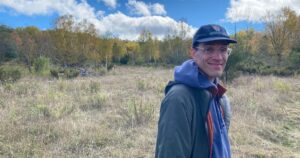
Volunteer Lead Property Steward Richard Raper shares some of his favourite things about KLT’s Ingleton-Wells nature reserve in North Kawartha.
We know you love walking along the trails at Kawartha Land Trust’s (KLT) public access properties throughout the Kawarthas and that you likely have favourite spots that you like to visit.
Volunteer Lead Property Steward Richard Raper shares some of his favourite hidden gems that you can find at KLT’s Ingleton-Wells property this time of year.
A Birdwatcher’s and Nature Lover’s Haven
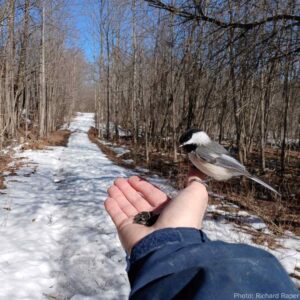
KLT’s Ingleton-Wells property is known to many birdwatchers and nature lovers. In the fall, and early winter (after most birds migrate) the Black-capped Chickadees, and sometimes Nuthatches, will often come to your quietly outstretched hand if you offer them sunflower seeds.
Blue Jays and Crows can often be seen and heard not too far away. If you are going to hand feed the birds, gloves should be worn during feeding and/or hand sanitizer should be used immediately afterwards.
A Taste of the Past
Although the Ingleton-Wells property is mostly forested, there are signs, more easily seen in the fall and early winter, of Settlers’ past agricultural use of the property.
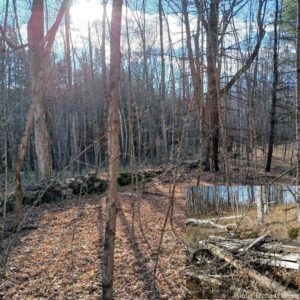
The stone fences you might see in the forest indicate that either one or both sides were likely previously used for pasture or possibly for crops that would have survived on the shallow, rocky soils.
On the property, there are the remnants of old fields that are naturally re-seeding themselves back into forested ecosystems. There is also evidence that the property was once used for the production of maple syrup — the very deteriorated wood wagon — with the concrete remains of an evaporator structure on the edge of the Reids Road parking area.
Saplings for the Future
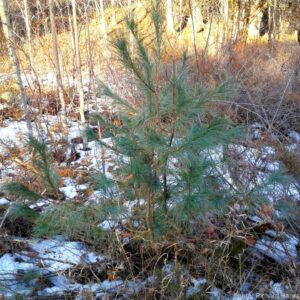
There are a few larger Eastern White Pine trees on the Ingleton-Wells property that are “seeding in,” meaning the seeds from these more mature trees are naturally regenerating the forest surrounding them. In some areas, the small Eastern White Pine seedlings and saplings are more easily seen during late fall and early winter when deciduous trees have lost their leaves.
These young pine trees are becoming established despite the competition for light, space, and nutrients from other trees and shrubs. Eastern White Pine trees are moderately shade tolerant, meaning they can grow even if they’re not in full sun.
Did you know that the Eastern White Pine is Ontario’s provincial tree?
Wildlife in Nature
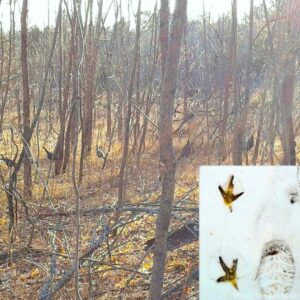
On a walk on the trails at Ingleton-Wells, a keen eye can spot wildlife or evidence thereof in the fall and early winter when they are not hidden by the leaves on small trees and shrubs. You might even see an Eastern Wild Turkey or two (or more!) and, if not, you might find their quite distinctive tracks after an early light snowfall.
A hike on the trails a day or two after an early light snowfall usually results in evidence of several different wildlife species that use the property, including White-tailed Deer, squirrels, Raccoons, Coyotes, and others. If you are lucky, a deer might cross your path.
Thanks for sharing your hidden gems, Richard!
Ingleton-Wells was generously donated to KLT in 2011 by the Ingleton and Wells families to ensure its permanent protection. This 73-acre property in North Kawartha is an incredible place to visit to reconnect with nature.
The community trails at Ingleton-Wells are connected to a larger network of trails, KLT’s Stony Lake Trails, that includes trails on KLT’s Jeffrey-Cowan Forest Preserve and property owned by nearby Viamede Resort.
Photos: Richard Raper